
After years of being told what she should sell, Sarah Khan finally built a business around the work she actually wanted to do.
By the time Sarah came to me, she'd already spent years working with so-called coaches trying to figure out how to turn her experience into an offer she felt excited about.
She knew how she helped people. She could get into a conversation with someone, see patterns they couldn't see, ask the right questions, and help them make sense of what they actually wanted.
But she couldn't package that into a sellable offer. She couldn't even really explain what she did. And every time she'd tried to get help figuring it out, she was pushed toward something easier to package.
You're great at operations, so sell operations. You've done a TEDx talk, so help people get TEDx talks.
Pick the obvious, practical skill. Build an offer around that. Except…she didn't want to do any of those things.
She'd already learned what happens when she stops listening to everyone else's roadmap.
Sarah had spent two years trying to land a TEDx talk. She hired coaches. Scriptwriters. Even a former TEDx producer.
And she kept getting advice about what she should talk about—including that the story she actually wanted to tell wasn't the one that would get her on the stage!
Eventually, she got frustrated. She ditched everyone else's roadmap, submitted the talk she wanted to give...and it was accepted immediately.
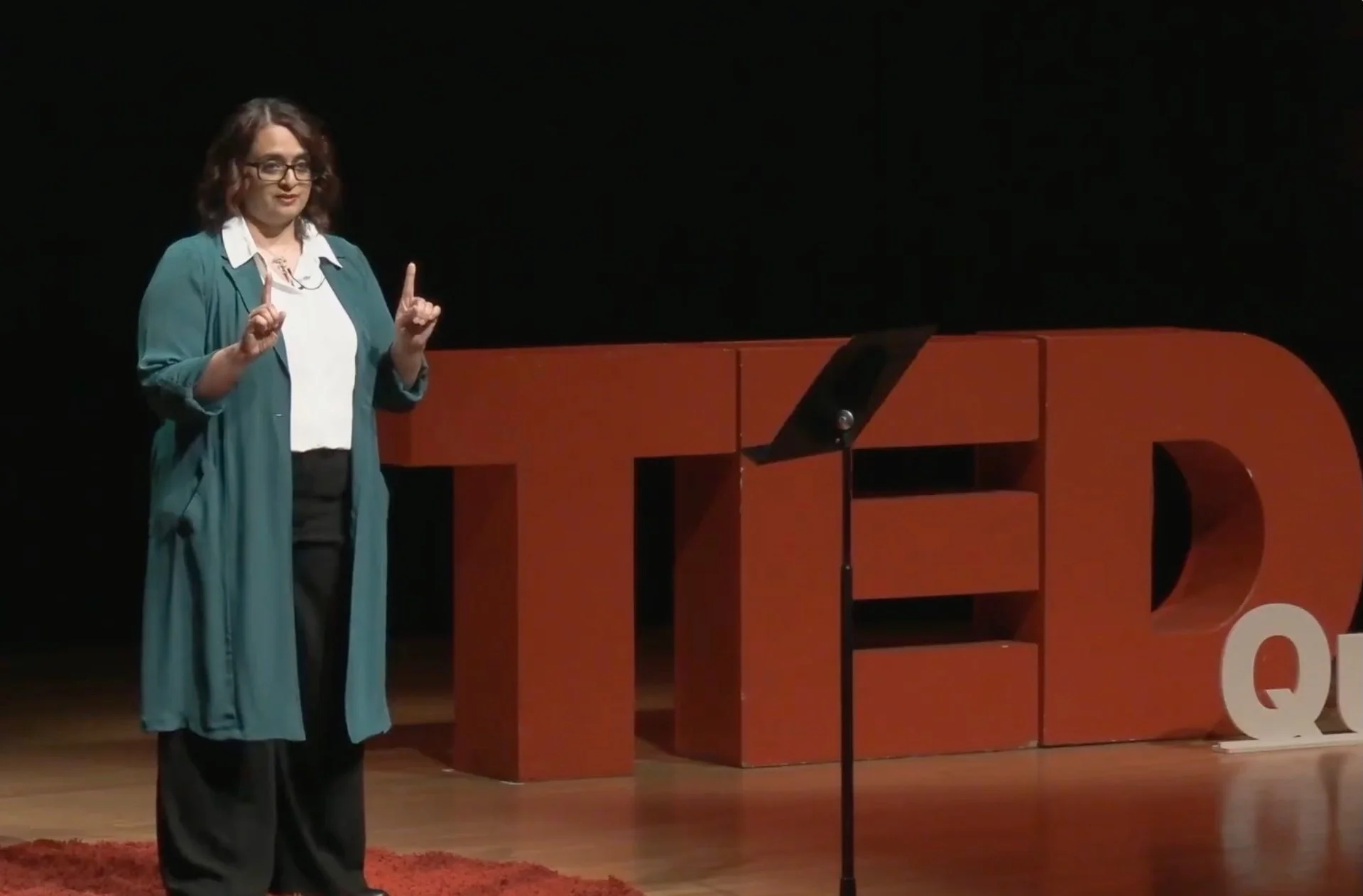
After two years of being told what would get her onto a TEDx stage, Sarah submitted the talk she actually wanted to give. She was accepted on her first try.
Click the photo to see her speech!
That experience left her with a much bigger question—if they were that wrong about the TEDx talk, what if they're also wrong about the business I want to build?
She still wanted a business. She just had no idea how to turn what she knew she could do into an offer someone could understand and buy.
We didn't need to invent a new business. We needed to uncover the one that was already there.
That's where our work started. I didn't give Sarah some framework and tell her to fit herself inside it. Instead, we started pulling apart what was already there.
We looked at how she naturally helped people. Her experiences. Her stories. The problems she could spot almost instantly. The things clients came to her for. The patterns running through all of it.
Then we did market research to find the people who actually needed those things—and the language they used to describe the problem.
Slowly, the amorphous “I know what I do, but I don't know how to explain it” started becoming an offer.
We clarified:
- Who she was uniquely equipped to help
- The problem those women were actually experiencing
- The transformation Sarah could offer them
- How to package that transformation into a sellable offer
- Her positioning and Irresistible Buying Message
- The core philosophies and content pillars behind her work
- The stories, frameworks, examples, and ideas she could use to talk about it
Then we ran into another problem—Sarah knew too much!
“Wait. You know everyone doesn't know that, right?”
This became one of my favorite parts of working with her.
Sarah would casually explain something incredibly insightful and then move right along because, to her, it was obvious.
And I'd have to stop her. “Wait. You know everyone doesn't know that, right?” 😂
She'd been immersed in this work for so long that she couldn't see where her own expertise began. Things she'd spent decades learning felt like common knowledge.
So part of my job became helping her recognize her own intellectual property—and then making it simpler, not more sophisticated.
Because the best way to help someone isn't to assume they already understand everything you understand. It's to assume they don't, then start there.
Her marketing system became a vault for everything she didn't realize she knew.
That's also when her On-Demand Marketing System (ODMS) became more than a content system.
As we worked, we kept finding pieces of Sarah's intellectual property everywhere.
In our calls and her TEDx talk. In stories from her career. In market research conversations. In the questions she naturally asks clients. In phrases she'd throw out casually and not realize were brilliant.
As we captured them, her ODMS became an IP vault—an organized home for the stories, frameworks, beliefs, examples, quotes, and ideas that make up her body of work.
Instead of sitting down and asking, “what should I post about?” Sarah now has a growing library of things she already thinks, knows, teaches, and cares deeply about.
“Everything feels possible again.”
The result wasn't just better messaging. Sarah finally had words for the business she'd been trying to build all along.
She had an ideal client she could recognize. A problem she could articulate. A sellable offer built around the work she actually wanted to do. Messaging that made that work understandable to someone outside her own head.
And a body of intellectual property she could continue building on instead of reinventing every time she needed to create content.
At one point during our work together, Sarah said “everything feels possible again.”

“Everything feels possible again.”
SHE finally had the language, positioning, and structure to build a business around the work she actually wanted to do.
Which is the best description of her transformation.
Because we didn't invent a new expertise for Sarah. We didn't tell her which of her existing skills would be easiest to sell.
We found the value in what she was already doing, gave it language and structure, and turned it into something other people could finally understand—and buy.
